
Do you remember how you learnt to ride a bike? Someone probably explained the „laws of cycling“ to you: keep your weight centred, lean into the bend. You didn't understand a word. Then you got on the saddle and made mistakes - steering too hard, not pedalling, leaning too far to the side. Every mistake provided immediate feedback. You corrected it and tried again. At some point it clicked, and you've never forgotten it since.
It was a great learning experience that has stayed with you to this day. But here's the uncomfortable truth: the physics behind cycling - gyroscopic forces, torque, balance - didn't open up to you at all. You have learnt, to drive, not Why driving works.
This gap between experience and understanding is at the centre of science lessons. And closing this gap is more important than most people realise.
The gap between doing and understanding
Many teachers know the frustration. Learners love experiments. They remember the spectacle: mixing chemicals, closing circuits, refracting light through a prism. But research shows time and again that learners often fail to grasp the underlying concepts. The interest lasts until the end of the lesson - researchers speak of situational interest - and then evaporates.
The practical activity detaches itself from the theory that should actually make it tangible. Learners enjoy doing, but thinking falls by the wayside.
So the crucial question is: can experiments be designed in such a way that the mistakes made by learners can be minimised? itself become a physics lesson? That an incorrectly steered bicycle not only teaches balance, but also Newton's laws? That experience and understanding arise together?
What research-based learning really means
Inquiry-based learning is not just following a recipe. It is not „Do steps 1 to 7 and write down your observations.“ This approach produces obedient learners, not curious ones.
Real research follows the scientific cycle: observe, form hypotheses, experiment, analyse, draw conclusions. Learners think like researchers because they work as researchers. Barak and Shakhman (2008) showed that linking theory and practice through structured enquiry promotes higher-order thinking skills - skills that work beyond the classroom. He, Xie and Lavonen (2022) confirmed that this approach builds scientific thinking skills that last well beyond the individual lesson.
What does this look like in practice? A class of twelve-year-olds is given motorised vehicle kits. The teacher does not explain Newton's second law. Instead, she asks: „What do you think affects the speed of your car?“ The learners make assumptions. Some say weight. Some say wheel size. Some say the angle of the ramp. They record their hypotheses in writing.
Then they test. They change the mass of their vehicles. They swap wheels. They vary the ramp angle. They collect data - real data from their own experiments. And when they compare the results in class, patterns emerge. Force, mass, acceleration. Newton's laws do not emerge from a textbook, but from evidence that the learners have collected themselves.

Mistakes play a central role here. Anyone who predicts that a heavier car will drive faster and then discovers the opposite through their own data - it is precisely in this moment of surprise, this productive failure, that deep learning occurs.
Six pillars that support the whole
Structured research requires more than good will. Matti Rossi's (2022) pedagogical analysis identifies six pillars that make active science didactics effective.
Activate. All learners experiment, observe and contribute - not just the teacher who demonstrates at the front. When everyone has materials in their hands, passive observation becomes impossible.
Motivate. Tasks are linked to everyday life. The technology behind everyday devices - smartphones, cars, loudspeakers - is always based on scientific principles. Combining science with what learners are already interested in arouses their curiosity.
Working together. Knowledge is created through social interaction. Learners work in pairs, discuss results and scrutinise each other's interpretations. The learning path is shared, not solitary.
Think critically. Structured research leads learners up Bloom's taxonomy - from memorising and analysing data to developing new insights. Creativity requires trial and error and free experimentation. Mistakes should not be avoided, but honoured.
Build up scientific expertise. In a world full of information, scientific literacy means being able to distinguish fact from fiction. Students who learn to evaluate their own experimental evidence acquire the skills they need to categorise claims in the news, on social media and in everyday life.
Take personal responsibility. When learners control their own investigations, they develop autonomy, a sense of responsibility and deeper motivation. Renninger et al. (2019) showed that it is precisely this form of autonomy that transforms fleeting situational interest into lasting individual interest - the kind of interest that shapes career choices and lifelong curiosity. The teacher does not lose any authority in the process. They gain respect as a companion.
What this means for your lessons
If you're thinking: „That sounds convincing, but I teach five classes a day and don't have time to develop research-based teaching units from scratch“ - then this article is aimed at you.
The practical paradox is real. There are enough methods - project-based learning, STEAM, research-based learning. But the question was never, which method is the right one. It always was: What specific experiments, investigations and teaching scenarios? Teachers need complete, ready-to-teach materials, not just files on an exchange platform. They need scenarios that explain how to start, which experiments to carry out, which questions to ask and how to keep learners engaged.
These materials are available. They contain methodological comments that explain the pedagogical rationale behind each activity. They include interactive surveys, playful elements and collaborative discussion prompts. They cover the entire research cycle - from the initial question to the final evaluation.
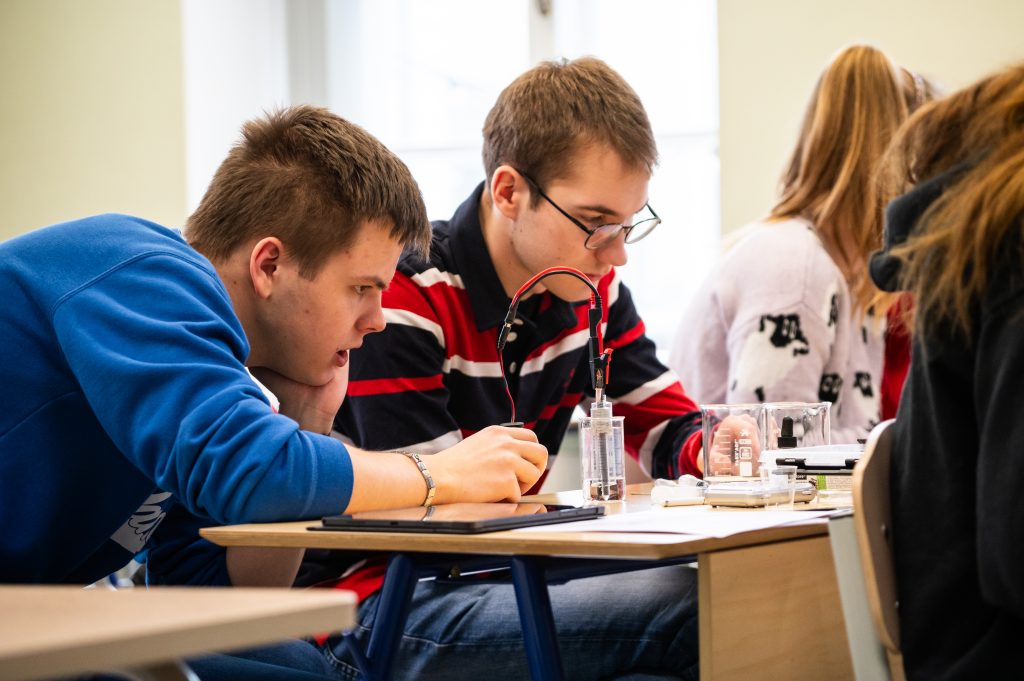
And they work. 303 schools across Estonia - Europe's number one in the PISA science rankings - work with this approach every day. Teachers save preparation time. Students do real science. The vicious circle of overwork, theory-heavy lessons and declining interest is broken.
A new look at the bicycle
Learning to ride a bike showed you something fundamental: that understanding comes from experience, from making mistakes, from trying again. The challenge of science education has always been to utilise precisely this power - and to combine experience with the underlying science.
It turns out: this is possible. With the right materials, the right structure and the right pedagogical framework, every classroom becomes a place where learners discover physics in the same way they once discovered balance: by doing, by failing, by understanding.
The Praktikal ecosystem combines research-based learning with a digital platform and structured teaching scenarios. And the best thing is: using Praktikal is almost as easy as riding a bike. Give it a try. Find out more about Praktikal.
Sources: Abrahams, I. and Millar, R. (2008); Barak, M. and Shakhman, L. (2008); He, Y., Xie, C. and Lavonen, J. (2022); Renninger, K. A. et al. (2019); Rossi, M. (2022).