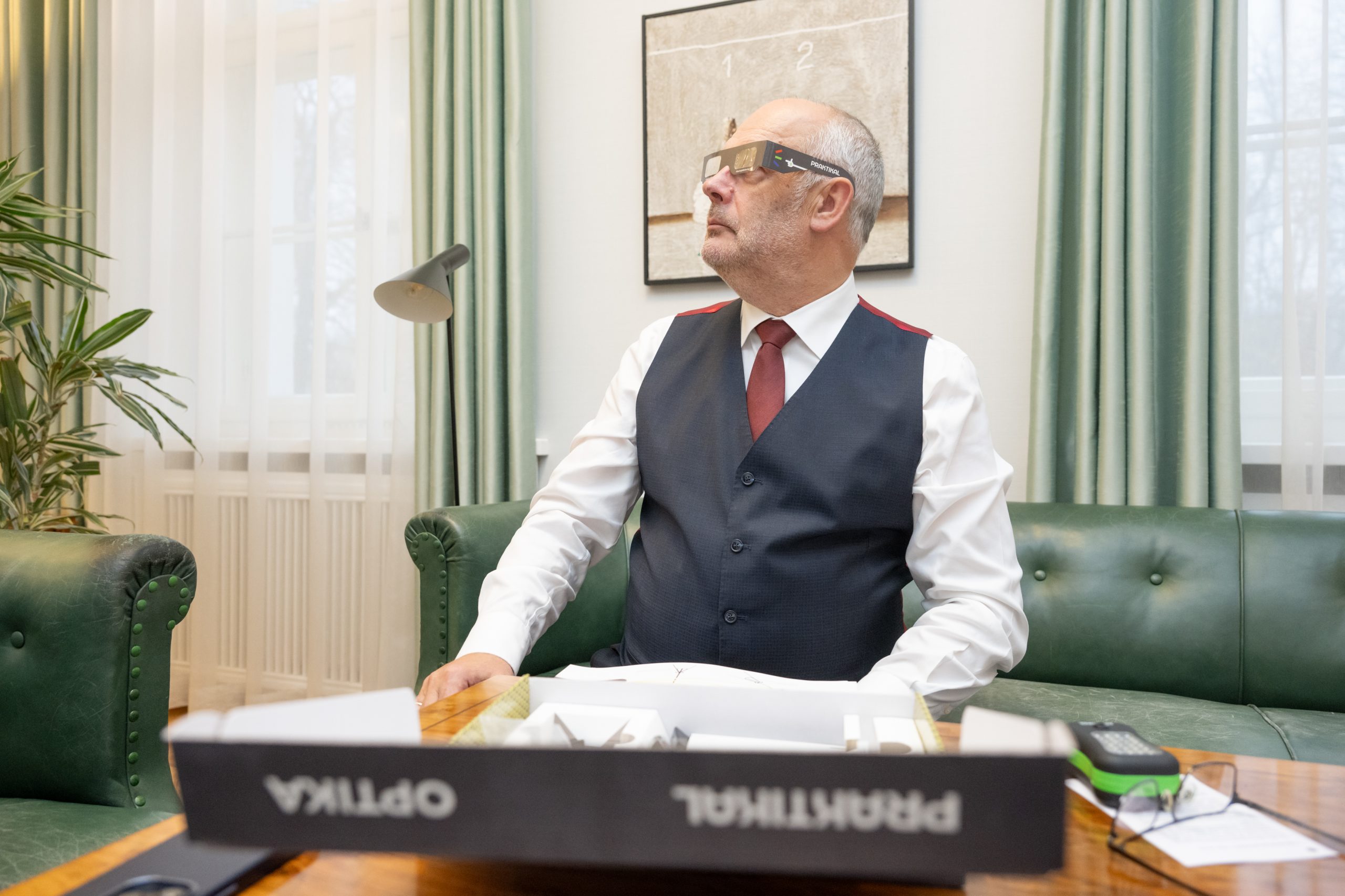

What if your next optics unit didn't start with the law of refraction on the blackboard, but with learners making objects disappear?
The best science lessons start with a moment that doesn't quite fit together. A coin that suddenly reappears. A ghost floating in the air in the middle of the room. Light that splits into colours and comes together again. Moments like these generate genuine curiosity - the kind of curiosity that makes learners lean forward and Why even before a technical term has been used.
Praktikal's optics curriculum is based precisely on this principle. In 6 subject areas and 22 lessons, pupils do not learn abstract ray diagrams by heart, they build functioning instruments, check predictions with real materials and discover the physics of light through structured, enquiry-based learning.
Today we present five experiments from the curriculum that are constantly changing the way learners engage with optics.
1. the missing coin
From topic area 5: Light is refracted - „Refraction of light“
Place a coin at the bottom of an opaque bowl. Ask the learners to step back until the coin disappears under the rim. Now slowly pour water into the bowl. The coin will reappear.
Silence falls in the room. Then come the questions.
This experiment is at the centre of the „Refraction“ lesson, in which learners trace light rays through glass and water, discovering that light changes direction as it passes from one medium to another. Using glass blocks and semi-circular glass models from the Praktikal Experimental Set, they observe how objects appear to shift from their actual position when viewed through an optically denser medium - the same principle behind the kink in the drinking straw.
Before someone says the word „refraction“, the learners think about it, Why the coin becomes visible again. They formulate hypotheses, test them and refine their explanations. The fact that a swimming pool looks shallower than it actually is suddenly makes physical sense. The explanation comes from observation, not from a formula on the blackboard. This is exactly how enquiry-based learning works: observing, surmising, experimenting, drawing conclusions. Learners develop a real conceptual understanding because they have experienced the phenomenon before they name it.
2nd Pepper's Ghost
From topic area 3: In front of and behind the mirror - „Reflection on glass surfaces„
Students build their own Pepper's ghost illusion - the same technique used in theatres and museums to create floating apparitions. Using a semi-transparent glass surface (a CD case works well), targeted lighting and a smartphone, they make objects float in empty space.
The lesson „Reflection on glass surfaces“ investigates what happens when light hits a transparent surface: part of it passes through and part is reflected. Learners discover that a sheet of glass transmits and reflects light at the same time, creating a virtual image that appears to lie behind the surface. By adjusting the lighting on both sides of the glass, they control which image dominates - the real object or its ghostly reflection.
The difference between real and virtual images creates real aha moments in the classroom. A virtual image appears where the light apparently comes from, not where it actually is. Learners realise that our brains assume that light travels in a straight line, so a reflection on glass creates the convincing illusion of an object floating in empty space. They construct the position of the virtual image geometrically and check their drawings against the illusion they have created themselves. The magic trick becomes physics - and the physics feels like a magic trick.
3. the rainbow maker
From topic area 5: Light is refracted - „Because light refracts“
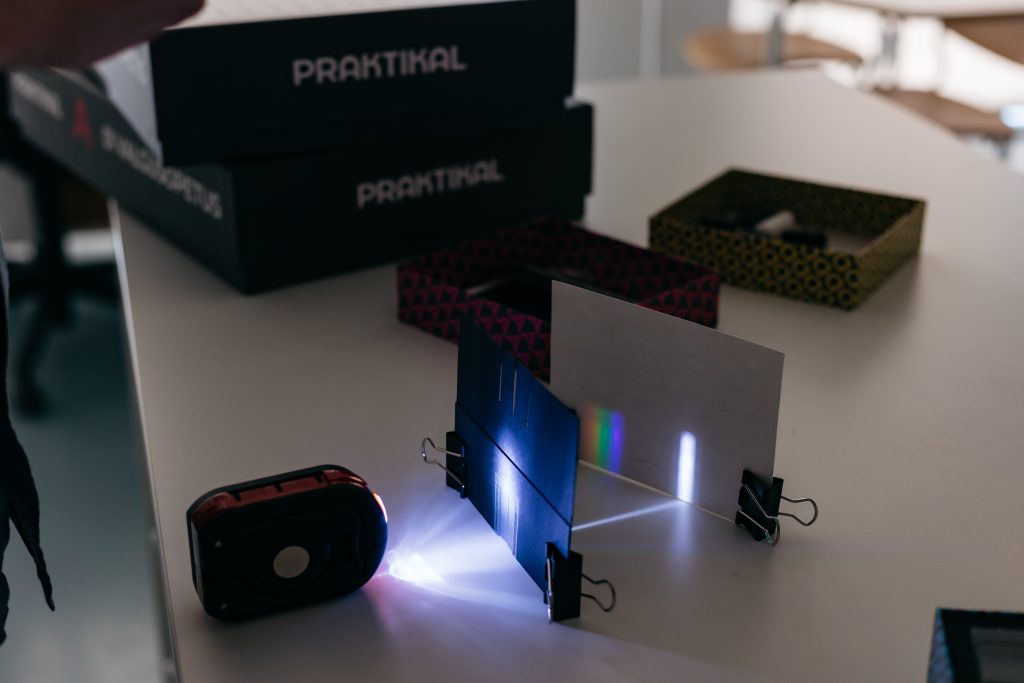
Give the learners a prism and a light source. White light enters on one side. On the other, a colour spectrum fans out. The learners create the famous Pink Floyd album cover and then ask: Can you put the rainbow back together again?
The lesson „Because light refracts“ combines refraction with colour. Different colours are refracted to different degrees when passing through glass, which is why prisms break down white light into its components. Learners test systematically: Does the order of the colours change when the prism is rotated? Can a single colour be isolated? What happens when you send a colour through a second prism?
Total internal reflection also occurs quite naturally here. If light inside the prism hits the surface at a flat angle, it cannot escape and is completely reflected back. Students discover that this is the same principle that makes fibre optic cables work and explains the silvery shimmer of an air bubble under water. Using prisms, semi-circular glass models and LED light sources with slit diaphragms from the experiment set, they move from trial and error to prediction to understanding. Dispersion and total internal reflection are no longer textbook concepts, but phenomena that they have experienced with their own hands.
4. build your own telescope
From topic area 6: Image formation - „Microscope and telescope“
Two converging lenses, an optical bench and a question: Which combination makes distant objects appear larger?
The „Microscope and telescope“ lesson is the culmination of the entire Praktikal optics course. At this point, the students have already worked with pinhole cameras, ray diagrams, real and virtual images and the human eye. Now they are putting it all together by building composite optical instruments.
The students start with converging lenses of different focal lengths and experiment. One lens with a short focal length close to the eye, one with a longer focal length aimed at the target and suddenly distant objects come closer. They measure the magnification, swap lenses and discover how the focal length determines what the instrument can do. They learn why a telescope needs a different lens combination than a microscope and build working models of both.
The educational strength here lies in the sense of personal responsibility. Learners do not follow a recipe, they make design decisions, test configurations and look for solutions if the image appears blurred or upside down. They apply everything they have learnt in the five previous subject areas: Reflection, Refraction, Image Formation and Lens Behaviour. A pair of lenses, correctly arranged, and the craters of the moon become visible. This is a moment that learners never forget.
5 The colour mixing paradox
From topic area 4: A colourful world - „Colours in digital media and art“
Point the red and green light at the same spot. The result? Yellow. Learners only believe it when they see it.
The lesson „Colours in digital media and art“ addresses one of the most fascinating contradictions in physics lessons: Additive light mixing (RGB) and subtractive colour mixing (CMYK) produce opposing results. Red and green colours produce brown. Red and green light produce yellow. Both are „correct“ - but the physics behind the two systems is fundamentally different.
Using colour filters (red, green, blue, cyan, magenta and yellow) from the Praktikal optics set, learners investigate both additive and subtractive colour mixing. They discover that a red filter does not „add red“, but absorbs everything except red. They look at the pixels of a smartphone up close and see the tiny RGB sub-pixels that create each colour on the screen. They test why a red apple appears black under green light and experimentally verify that the colour of an object depends on both its surface and the lighting.
This lesson ties in directly with the technology in your pocket. Every screen, every printer, every digital camera uses the colour physics explored here. When learners understand, Why screens use RGB and printers use CMYK, they have realised something really useful and solved a paradox that makes most adults wonder.

The red thread
These five experiments have more in common than good optics. Each follows the cycle of inquiry-based learning: observe a surprising phenomenon, form a hypothesis, test it with real materials and build understanding from the results. Learners do not engage with light in the abstract - they operate Optics, with their own hands, make predictions and discover when these predictions do not apply.
The Praktikal approach treats errors as data, not as failures. When learners predict that the coin will not come up again, or that red and green lights should add up to brown, the surprise drives learning deeper than any correct answer. Didactic research confirms this: Structured enquiry-based learning that ties in with everyday phenomena generates lasting conceptual understanding - not merely situational interest that fades after the lesson (Abrahams 2009; Renninger et al. 2019).
Spanning 6 topics and 22 lessons, the complete optics curriculum builds from „How does seeing work?“ to learners who can construct their own telescopes and explain why the sky is blue. Each experiment uses real materials - glass blocks, prisms, lenses, mirrors, colour filters, optical benches designed by teachers for use in the classroom.
Discover the optics set from Praktikal and the corresponding methodical learning environment with prepared teaching units - available in the DACH region via Koolest Solutions.