

This week I had the opportunity to Alliance for Applied AI & Innovation to speak at the GK Software education panel in Schöneck.
My topic: „Think digital. Learn practice. – Practical & AI“
This has confirmed an observation that I am currently making in almost all conversations with schools, providers and partners:
Between departure and disorientation
Hardly any topic is developing as dynamically as Artificial Intelligence. New tools are emerging on a weekly basis, and the possibilities seem boundless.
However, in the reality of schools, this dynamic often leads to a standstill due to being overwhelmed:
- Tool jungle: Uncertainty in selecting the „right“ solution
- Island solutions Overwhelmed by too many isolated tools
- Methodology vacuum Lack of clarity on how AI specifically improves teaching
The result: we're having many discussions but still see too little real application. AI in teaching fails not because of the technology, but because of the lack of practical application in everyday school life and the lack of methodology.

The real problem: there is a lack of practice
The debate is often conducted on a purely strategic level: What are the risks? What rules do we need?
This is important – but it doesn't answer the crucial question: How does AI help on Tuesday morning during the second hour?
How AI can really work in the classroom
An example is the Estonian solution Practical. The all-in-one solution offers the following options, among others:
- Grandfathering: Existing materials will be retained and can be adapted and extended.
- Hybridity Digital content and physical experiments are meaningfully combined
- Efficiency AI specifically supports the creation and adaptation of teaching units
With Praktikal, there is one solution. Not ten.
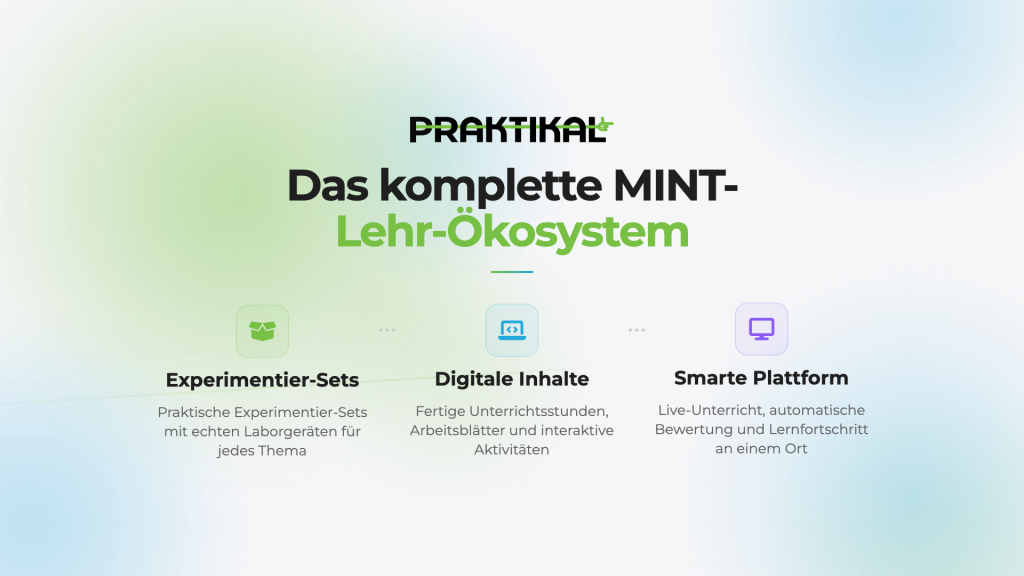
The practical methodology is based on a question: How can teaching become easier, better, and more practical?

My conclusion
If we want to seriously establish AI in schools, we must stop viewing it primarily as a technology project.
And starting to see it for what it is: A tool for better educationPossibilities
- Less discussion about possibilities
- More focus on application
- Less complexity
- More clarity in everyday life
Thinking digitally is important. Gaining practical experience is crucial.
What does AI mean in teaching in concrete terms?
- Individual learning support: AI helps to adapt content and tasks to different learning levels.
- Time savings for teachers: Teaching units, assignments and materials can be created and customised more quickly.
- Aids to teaching, not a replacement: AI supports teachers – it doesn't replace them.
- Integration instead of isolated solutions AI is integrated into existing materials and teaching processes.
- Practical application The focus is on practical classroom application – not on theoretical concepts.

