

However, in the hundreds of conversations at our stand, a central challenge crystallised that unites teachers across all types of schools:
„I have fantastic materials - from PowerPoint to physical experiments. But I just can't get them to make sense in the classroom.“
The problem in 2026 is no longer the lack of digital content. It is the Fragmentation.
The real problem: the „island solution“ trap
Teachers today juggle an impressive arsenal of tools:
- Interactive whiteboard presentations
- Analogue worksheets, reference books & copies
- Physical experiment kits
- Digital simulations and learning apps
- Links
- and media from VHS to YouTube.
Variety is basically a good thing. However, these „elements„ of “teaching modules„ are often isolated from one another. One media break follows the next. This not only costs valuable teaching time, but also breaks the “flow" of the pupils. When technology becomes an obstacle, the pedagogy suffers.
The new role: the teacher as curator
One of the most important findings of the trade fair: We need to stop seeing teachers as mere „users of software“. In a world full of content, the teacher is the Curator of the learning experience.
A modern curator:
- Select specifically: He uses the best video from YouTube, combines it with his own PDF and a haptic experiment.
- Connects worlds: It bridges the gap between haptic activity (analogue) and documentation/evaluation (digital).
- Keeps the navigation: He knows at all times which small group is currently stuck in the experiment and who has already completed the simulation.
In short: Teachers don't need a „next tool“, but a bracket that holds everything together.
How Praktikal closes the gap
This is exactly where Practical on. Gaining more time for pedagogy does not mean „redoing everything“. Instead, with Praktikal we offer a place where everything comes together:
- Grandfathering: Your tried-and-tested PowerPoints and worksheets simply move with you.
- Real integration: The physical experiment is not replaced by an app, but rather supplemented and made controllable by it.
- Live visibility: A dashboard shows where the class stands in real time - without having to look over your shoulders.
Why this makes a difference for schools, media centres and school authorities
It has long been clear that infrastructure alone does not teach. What is needed is Structure. In a market characterised by great diversity and different technical requirements, flexible solutions are needed that adapt to the teacher - not the other way round!
From the exhibition stand to the classroom: experience it for yourself
The response at didacta was overwhelming. Many visitors reflected on us:
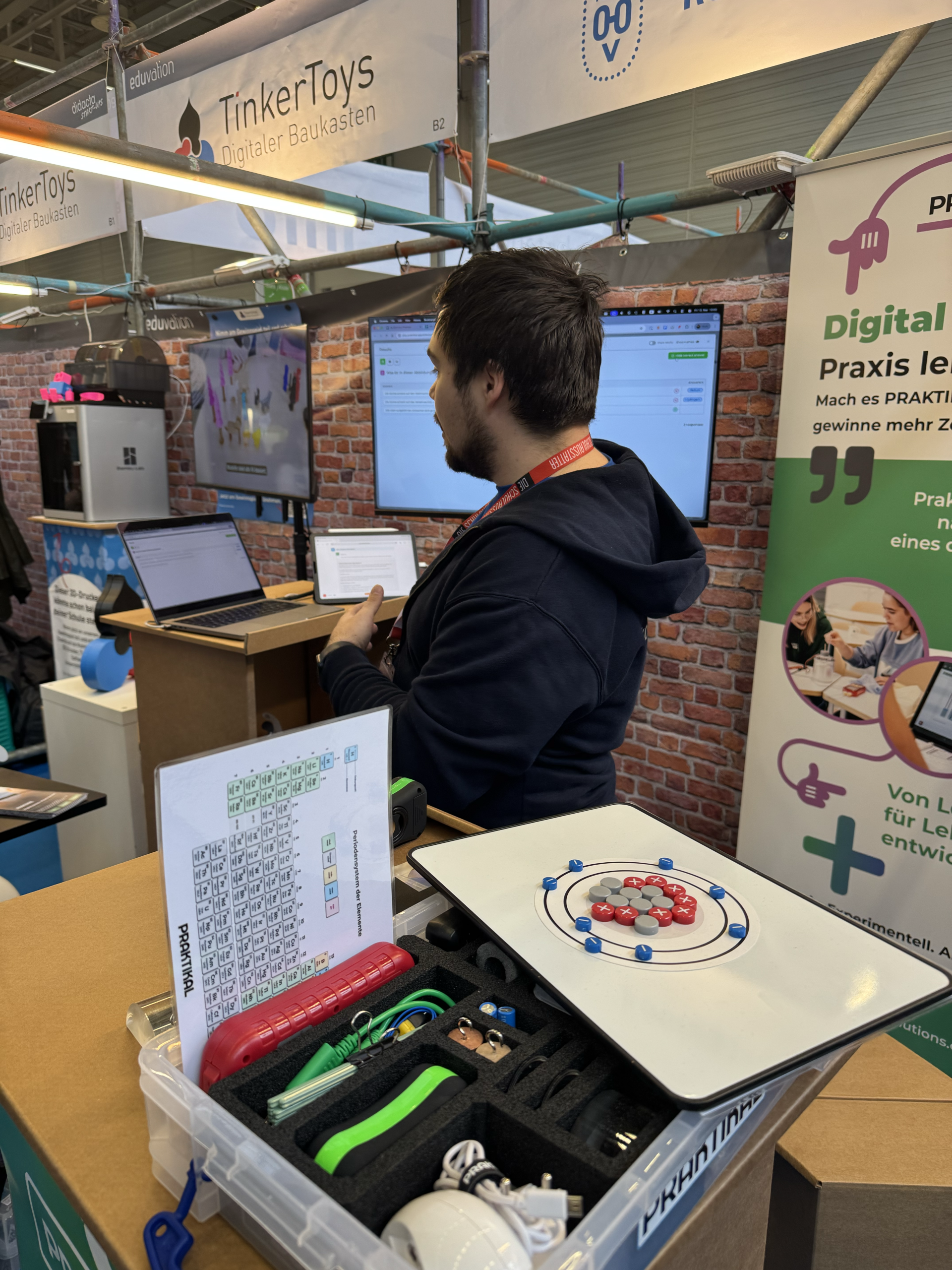
„This is exactly how teaching should always work.“
To ensure that this momentum does not fizzle out, we invite you to see the solution live in action. In our compact webinars, we will show you directly from the field:
- What a smooth workflow without media discontinuity looks like.
- How to integrate your existing materials in just a few minutes.
- How to regain control over your learning progress.

